
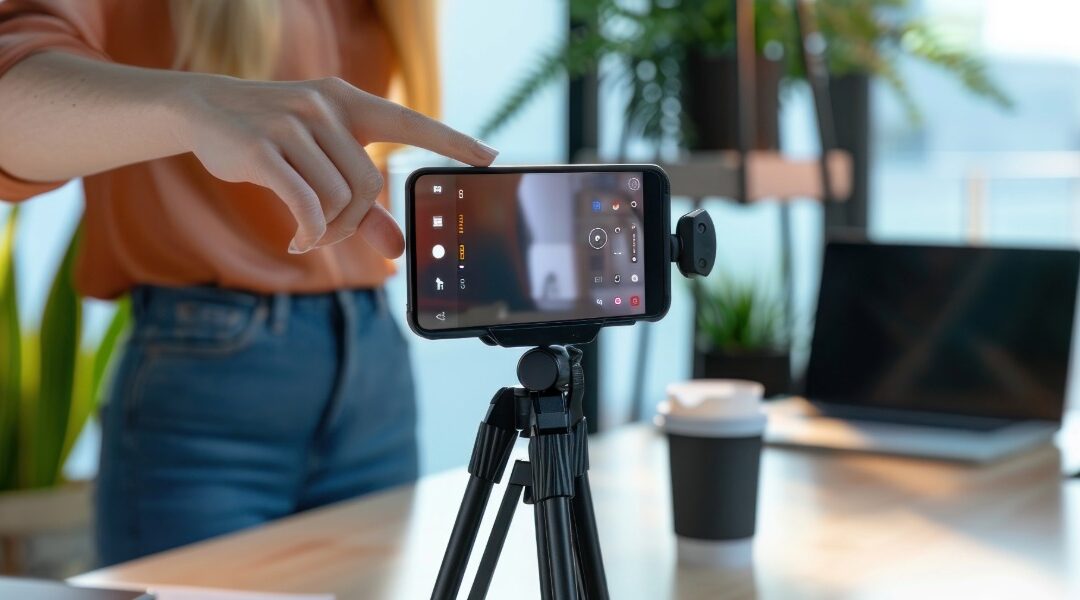
Since everyone has a video camera in their pocket these days, it should be easy to create a video memoir for yourself. Just prop the camera up, press record and talk. Right?
Well, maybe not. In fact, so many people are saying, “Whoa, that’s more work than I thought” that there is a boom in professional video memoir services (like mine). All that notwithstanding, if you’d like to take a crack at being your own interviewer, videographer and editor, here are a few helpful tips.
3 Ways to make your DIY video memoir better.
One: Think through which memories you’re going to share.
One easy way is to think of your life, and your family, in chronological sections:
- What you know about family history before you were born.
- Your childhood
- Young Adulthood
- Career
- Marriage and Family
- The Middle Years
- Retirement
Then think through specific memories you’d like to share in each section, chronologically.
When you’ve got that in hand, recruit a friend or family member to be the “interviewer,” to walk you through the questions you’ve come up with. Even if they do nothing besides read each question in order and let you answer you’ll be surprised at how much easier this makes things.
Two: Know how to shoot decent video with your phone.
Most smartphones have cameras capable of shooting potentially stunning 4K video – but most people don’t take the time to use them correctly. Here are a few “must-dos” if you’re going to capture your family history with your phone.
Use the camera on the back of the phone.
Don’t film in selfie mode – the front camera is never as good as the one on the back. If you are the subject of the memoir, you’ll need to someone to frame the picture for you. Also, please, please wipe off the lens; after all day in your hand, pocket or purse, that thing is anything but clean and clear.
Use a tripod with a phone adapter.
A cheap tripod, or even a light stand, will hold the camera steady and allow you to position it. Inexpensive phone holders are easily found (search for “phone tripod holder” or “phone tripod mount”).
Be mindful of lighting.
Make sure that there is good light on your face(s) – and no strong
light (like a window) behind you. If you can, use natural light by
sitting hear a window, with the light coming from one side (again,
NOT from behind).
Be sensitive to sound.
Phone mics are designed to pick up sound close to them – so try to position the phone no more than a few feet from your faces. Otherwise the voices will be weak and the room noise too prominent.
For better sound, you can buy an “shotgun” mic for your phone. Again, they are plentiful – just search for “phone shotgun mic” and make sure it has the proper connection for your model phone.
Try to “edit in the camera.”
Unless you’re familiar with editing software, your best bet is to be well organized with your interview questions, have your “volunteer interviewer” walk through them in order, without digressions or pauses, and then just use the video as is.
Editing in the camera will give you a video record of you telling your stories, but if you want to make it more watchable, teach yourself how to use whatever video editing software that comes included with your computer (e.g. Apple iMovie) or one that is free to use (e.g., Clipchamp for Windows PCs). They are relatively easy to learn for basic tasks – and instruction tutorials abound on YouTube.
THREE: Keep it short.
Our digital lives have given us the attention span of a gnat, so don’t think that your grandchildren are going to wade through an hours-long epic. Keep it short – 30 to 60 minutes, and ask your interviewer to be your timekeeper.
One way to get a better video memoir than you can do yourself.
The simplest, highest quality approach to creating a memoir on video is, yes, to hire a video memoir service like mine, if you can find one in your area. It will not save you as much money as a DIY approach, but it also may not cost as much as you think. For the benefits of using a professional, I refer you to my home page.
The most important thing about video memoirs.
The best video memoir… is the one you actually get done. Whatever approach you choose, I encourage you to save those memories, and save them now. Your family will thank you.